

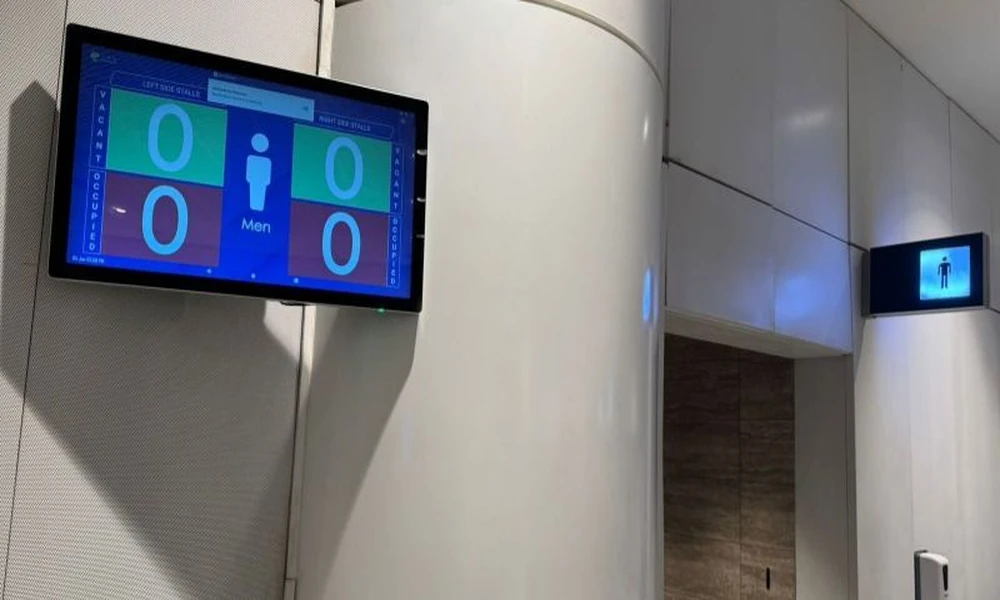
In airports and stadiums, the restroom line is often the first sign that a facility is under strain. United States air traffic serves about 2.9 million airline passengers on a typical day (Federal Aviation Administration), and restroom demand in terminals rises and falls with every wave of arrivals and departures. Small details that help users find an open compartment faster have an outsized effect on how a busy restroom performs.
Why does finding an open compartment take so long?
Finding an open compartment takes time when users cannot tell which doors are in use. People walk the length of the restroom, push on locked doors, or wait behind a door that is actually vacant. Each wasted second compounds when hundreds of users arrive within minutes.
Which signals help users decide quickly?
Several cues help users decide quickly:
- Clear red and green occupancy indicators on each door
- Doors that rest slightly open when compartments are empty
- Consistent compartment spacing that reads as a pattern
- Lighting that makes indicators visible from the entry
How do occupancy latches support both speed and safety?
Occupancy latches support speed by showing status at a glance and support safety by allowing staff access in an emergency. Some phenolic partition systems pair self-closing doors with an occupancy latch that includes an emergency unlatching device and shows when a stall is in use (ASI Accurate Partitions). Facility staff can open a compartment from outside if a user needs help.
Why does emergency access matter in large venues?
Emergency access matters because large venues see medical events every day. Staff must reach a person inside a compartment quickly without tools, while the latch still gives users confidence that the door is secure during normal use.
How do plumbing codes shape fixture counts in assembly buildings?
Plumbing codes shape fixture counts by occupancy type, and assembly buildings such as stadiums carry their own ratios. Model plumbing codes assign different minimum water closet ratios for men and women in stadiums and arenas, reflecting differences in restroom use (International Code Council). Even with code-compliant counts, poor wayfinding inside the restroom can create lines.
Where do peaks occur in stadiums?
Peaks occur at predictable moments such as halftime, intermissions, and the end of an event. During those windows, restrooms can fill in minutes, so every compartment needs to be found and used without hesitation.
How do airports manage restroom demand differently?
Airports manage restroom demand differently because travelers carry bags, children, and limited time. Wider compartments, clear signage, and visible occupancy indicators all reduce friction. Many airports also monitor restroom traffic so cleaning crews can respond before a restroom falls behind.
What should designers coordinate early?
Designers should coordinate door swing, indicator placement, lighting, and sightlines from the entry. Testing the restroom layout from a user’s point of view reveals where indicators are hidden or where doors block the view of other compartments.
How does traffic volume change partition durability needs?
Traffic volume changes durability needs because every user operates a door, latch, and indicator. The busiest airports handle more than 100 million passengers a year (Airports Council International), so even a small failure rate in hardware turns into dozens of out-of-service compartments. Robust latches and hinges keep compartments available when demand is highest.
Why does a closed compartment matter so much?
A closed compartment matters because it removes capacity at the worst possible moment. Facilities that track out-of-service compartments and repair them quickly protect their effective fixture count and keep lines from building during peaks.
How can technology help?
Some venues add sensors that report compartment use to operations staff. Data on peak times and usage patterns helps managers schedule cleaning and repairs between surges rather than during them.
What is the takeaway for high-traffic facilities?
Occupancy indicators are a small component with a large effect. Facilities that pair visible indicators with emergency-ready latches and thoughtful layouts move more people through each restroom and keep lines shorter when demand peaks.
