
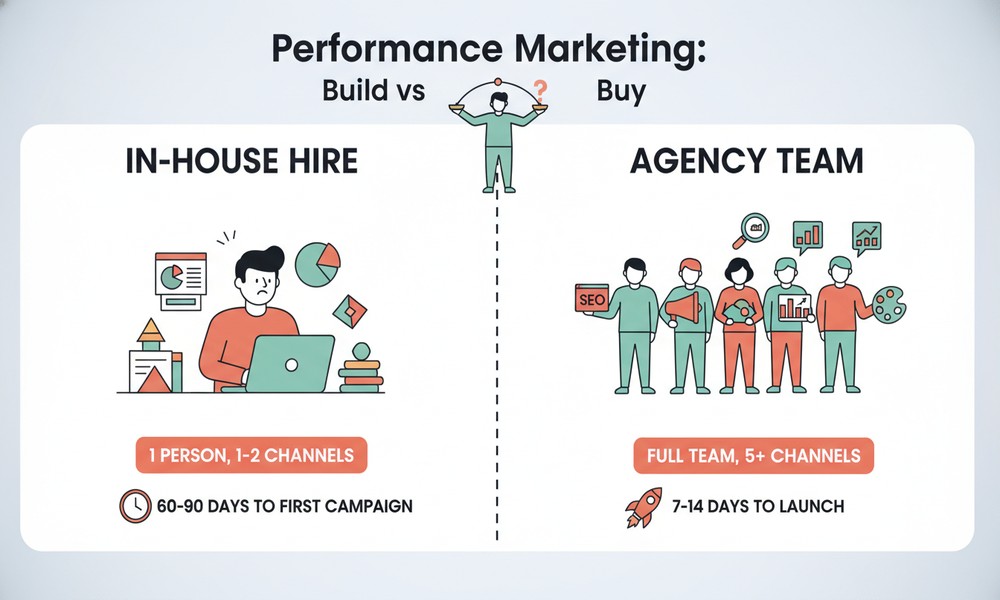
You have budget for one senior marketer or a performance marketing agency. Not both. Your CEO wants ads live last week. Your recruiter says a good hire takes three months.
This is the build-vs-buy decision that stalls more startups than any product debate. Here’s how to think about it without the bias.
Why This Decision Is Harder Than It Looks
The obvious argument for in-house: control. Someone embedded in your product, your culture, your Slack channels. That argument is real — and incomplete.
A single hire covers one, maybe two channels well. Your startup needs paid search, paid social, SEO, analytics, and creative. That’s five skill sets. One person can’t do all of them at a senior level. So you hire for the most urgent channel and neglect the rest.
The agency argument has its own blind spots. Agencies split attention across clients. Communication adds latency. They don’t live in your product daily. Some agencies hide behind vanity metrics because they’re managing 30 accounts with a team built for 15.
Neither option is universally right. But startups systematically underestimate the hidden costs of building in-house and overestimate the risk of working with the right agency.
The question isn’t agency or in-house. It’s which option gets you to your next milestone faster with less waste.
What to Evaluate Before You Decide
True Cost of an In-House Hire
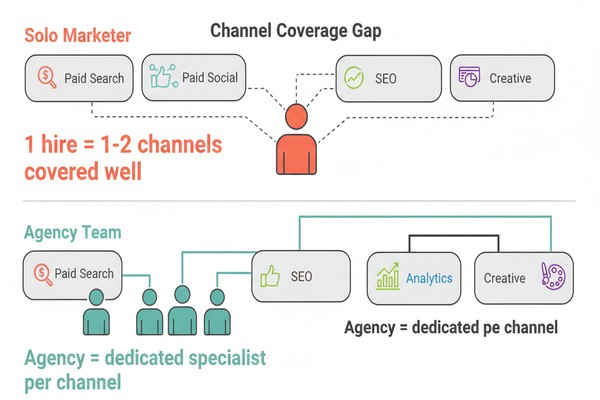
A senior performance marketer costs $120K-$160K in salary alone. Add benefits, tools, management overhead, and ramp time. You’re looking at $180K-$220K annually before they produce a single result. And that covers one person’s skill set.
Channel Coverage Requirements
List every channel your growth plan requires. Paid search. Paid social. SEO. Analytics. Creative production. If the list exceeds two channels, a single hire won’t cover it. A full-service marketing agency gives you a team of specialists across all channels from day one.
Speed to First Results
An agency with startup experience is running campaigns in week one. A new hire needs 30 days to onboard, 30 days to audit, and 30 days to optimize. That’s a full quarter before meaningful output.
Data and AI Infrastructure
Performance marketing now requires automated bid management, predictive analytics, and real-time dashboards. Building that infrastructure from scratch takes months. Agencies with AI-powered workflows bring it pre-built.
Flexibility at Inflection Points
Startups pivot. Budgets shift. If you hire a LinkedIn Ads specialist and then realize your CAC is 3x lower on Google, you’re stuck. Agencies reallocate across channels without a hiring cycle.
Making the Hybrid Model Work
Start with an agency, then layer in-house. Use the first 6-12 months with an agency to identify which channels are your primary growth drivers. Hire in-house for that specific channel once you have enough data to justify the role.
Give your agency direct access to product and sales data. The number one reason agencies underperform is data starvation. Connect your CRM, your product analytics, and your revenue data. The best agencies use this data to build automated attribution models that a marketing agency analyst would take months to create manually.
Set a clear RACI between in-house and agency. When you go hybrid, define ownership explicitly. The agency owns campaign execution and optimization. Your in-house marketer owns brand voice, product messaging, and internal alignment. Overlap creates confusion and finger-pointing.
Benchmark agency cost against team cost, not person cost. A $15K/month agency retainer replaces a paid media manager ($140K), an SEO specialist ($130K), an analytics hire ($150K), and a creative resource ($120K). That’s $540K in salary against $180K in agency fees. The math isn’t close.
|
Factor |
In-House Hire |
Performance Agency |
|---|---|---|
|
Annual cost |
$180K-$220K (one person) |
$120K-$180K (full team) |
|
Channels covered |
1-2 |
5+ |
|
Time to first campaign |
60-90 days |
7-14 days |
|
AI/automation tools |
You build it |
Pre-built |
The Clock Is Running
Your competitors made this decision six months ago. The ones who chose well are compounding data advantages across every channel. Their retargeting audiences are bigger. Their quality scores are higher. Their CPAs are lower.
Every week without active, optimized campaigns is a week of lost data. Performance marketing is a learning system. The sooner you start feeding it, the faster it compounds. A three-month hiring process followed by a three-month ramp means six months of zero learning while your market moves.
Startups that pair agency speed with data-driven execution are seeing 37% lower customer acquisition costs within the first quarter. That’s not a theoretical improvement. That’s the bar. You’re either meeting it or falling behind it.